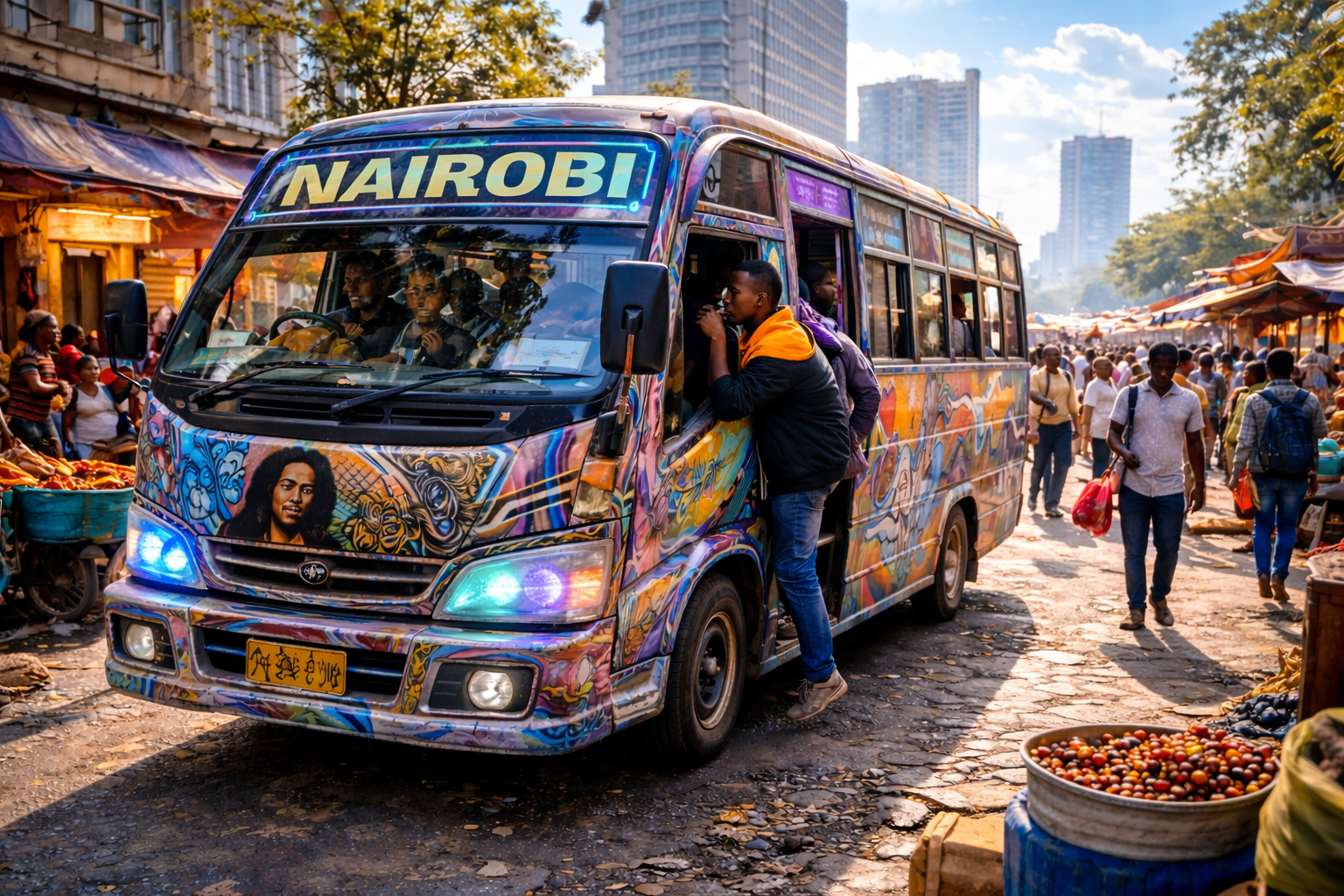
In Nairobi, the day begins on the road.
Before offices open and shops lift their shutters, matatus are already weaving through traffic, music spilling out of open windows, conductors calling destinations in sharp, rhythmic bursts. Routes like Ngong Road, Rongai, Thika Road, Jogoo Road, and Waiyaki Way come alive with colour and sound. This is not just transport. It is a moving expression of the city itself.
Matatu culture is built on movement, but also on negotiation of space, time, and survival. Every journey reflects Nairobi’s pace: fast, improvised, and intensely human. Drivers read the road like a living thing, adjusting to jams, roadblocks, and sudden downpours. Conductors manage crowds, fares, and tempers, switching easily between humour and authority.
Each matatu tells a story before it even moves. Hand-painted murals reference musicians, footballers, political moments, street slang, and global pop culture, reinterpreted through a local lens. LED lights pulse inside darkened cabins. Sound systems rival nightclubs. These vehicles are curated, not accidental — designed to attract riders, assert identity, and stand out in a crowded marketplace.
Behind the spectacle is a serious livelihood. Thousands of Nairobians depend on the matatu industry: drivers, conductors, graffiti artists, mechanics, sound technicians, stage coordinators, and vendors. For many young people, the sector offers one of the most accessible entry points into urban employment, demanding alertness, resilience, and street knowledge more than formal credentials.
Routes shape routines. Office workers time departures carefully. Students know which vehicles are fastest, which play the best music, and which drivers are smooth in traffic. Informal traders sell snacks and airtime through windows at traffic lights, their micro-economies synced to the city’s congestion patterns. The road becomes a shared workspace.
Matatus also reflect Nairobi’s inequalities. Congestion stretches short distances into long commutes. Fuel price fluctuations push fares up without warning. Regulatory crackdowns can alter routes overnight. Yet the system absorbs shock after shock, adapting where formal planning often lags.
Creativity remains its constant currency. What begins as street art on a matatu panel influences fashion, music, and youth identity across the city. Slang spreads from conductors’ calls into everyday speech. The matatu is both messenger and mirror of urban life.
For visitors, engaging with matatu culture offers a direct, honest encounter with Nairobi — one that cannot be staged or polished. Meaningful engagement comes from understanding that this is daily life, not spectacle, and that respect lies in observation rather than intrusion.
Grey Impala Safaris incorporates Nairobi’s urban culture into select city experiences that explore how transport, creativity, and informal economies shape everyday life. By working with local guides and cultural practitioners, these journeys help visitors understand the matatu system as a social and economic backbone, not just a curiosity.
In Nairobi, the city does not move quietly. It moves with sound, colour, negotiation, and invention — carried forward every day by matatus navigating streets that never stand still.