
A Serengeti safari is easier to get wrong than most people expect. The park is roughly the size of Northern Ireland, the wildlife moves between seasons, and two travellers who visit in the same month can come home with completely different experiences depending on which corner of the park they slept in.
This guide is built around the four decisions that shape your trip: when to travel, which part of the Serengeti to base yourself in, how many nights to give it, and how you get there. Everything else, including camp choice and budget, follows from those four.
Quick answers for planners
- Best overall months: late June to October for the dry season and the Mara River crossings, and January to March for the calving herds on the southern plains.
- Minimum sensible stay: three nights inside the park if you fly in, four or more if you drive from Arusha.
- Where to stay first time: central Serengeti (Seronera) for year-round game viewing, northern Serengeti (Kogatende) between July and October.
- Getting there: light aircraft from Arusha, Kilimanjaro or Zanzibar, or a scenic drive through the Ngorongoro highlands.
- Fees: budget for a daily park conservation fee per adult plus VAT, on top of your accommodation.
In This Guide
What makes the Serengeti different?
Serengeti National Park covers about 14,750 square kilometres in northern Tanzania. It was gazetted as a national park in 1951, and UNESCO inscribed it as a World Heritage Site in 1981 for its ecology and for the sheer scale of its annual wildlife movement.
The name comes from the Maasai word siringet, usually translated as the place where the land runs on forever.
Three things set it apart from other East African parks.
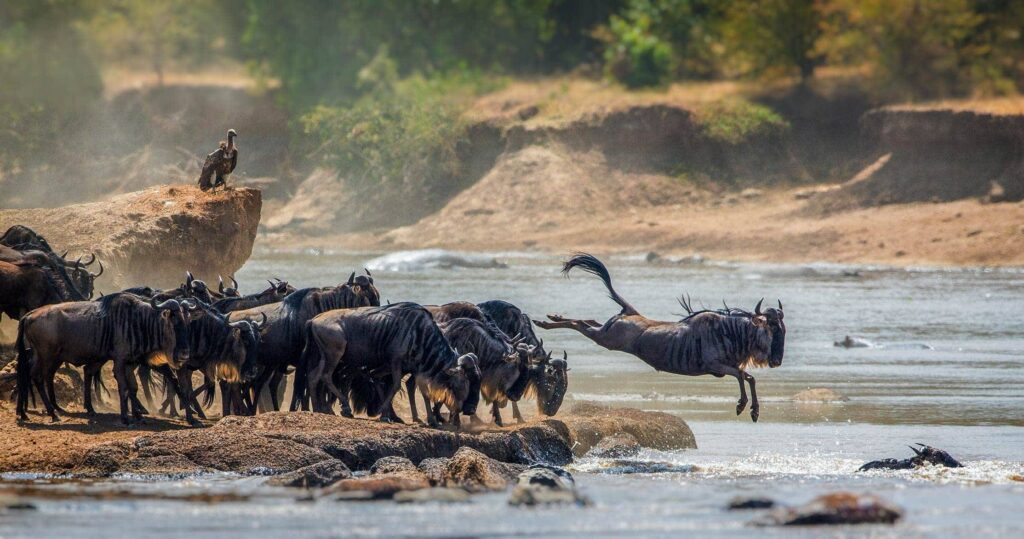
The first is the migration. Roughly 1.3 to 1.5 million wildebeest, along with several hundred thousand zebra and gazelle, move in a loop through the greater Serengeti and Maasai Mara ecosystem all year. The herds are never static, which is why timing and location matter more here than in a compact park such as Lake Manyara.
The second is predator density. The open plains, permanent rivers and resident prey support one of Africa’s largest lion populations, and the Seronera Valley is one of the more reliable places on the continent to find leopard resting in the fork of a sausage tree.
The third is space. Even in the busiest months you can drive for an hour in the western or northern sectors without meeting another vehicle, which is not true of every famous safari destination.
Serengeti areas explained: south, central, west and north
Picking the right sector is the single most useful thing you can do for your trip. Each one has a season.
| Sector | Base / airstrip | Peak months | Known for |
| Southern plains and Ndutu | Ndutu airstrip | Late December to March | Calving herds, cheetah on open grassland |
| Central (Seronera) | Seronera airstrip | All year | Resident lion and leopard, permanent water, easiest access |
| Western Corridor and Grumeti | Grumeti, Kirawira | May to July | Grumeti River crossings, quieter game drives, big crocodile |
| Northern Serengeti and Lamai | Kogatende | July to October | Mara River crossings, low vehicle numbers |
| Lobo and the northeast | Lobo, Klein’s Gate | June to November | Rocky kopjes, resident wildlife, very few vehicles |
A practical note on the southern plains: the Ndutu area straddles the park boundary and much of the calving ground sits inside the Ngorongoro Conservation Area rather than the national park. That matters for fees and for off-road driving rules, which are more relaxed in parts of the conservation area than inside the park.
Which sector suits which traveller
- First safari, limited time: central Serengeti. Game viewing is good in any month and the airstrip has the most flights.
- River crossings: northern Serengeti between late July and October, with at least three nights to improve your odds.
- Photographers: southern plains in February for predators on short grass, or the north in September.
- Repeat visitors and families wanting quiet: the Western Corridor or Lobo, paired with a mobile camp.
Best time to visit Serengeti
The Serengeti is a year-round destination, but the experience changes substantially by month. Tanzania has long rains from March to May and short rains in November and early December, and the herds respond to both.
June to October: the classic dry season
Grass is short, water is concentrated and animals are easier to find. From late July the herds build up along the Mara River in the north, and crossings can happen on any day during that window. This is also peak season for camp rates and for flight availability, so book early. Our 7-day Grumeti River migration safari is timed around the western and northern river systems for exactly this period.
January to March: calving on the southern plains
Between late January and mid March, several hundred thousand wildebeest calves are born on the short-grass plains in the south. Predator action is intense and concentrated, the landscape is green, and vehicle numbers are lower than in August. If your interest is cats rather than crossings, this is often the better half of the year.
April and May: the green season
The long rains bring dramatic skies, the lowest rates of the year and very few vehicles. Some mobile camps close, roads can be slow, and sightings take more patience. For travellers who have been on safari before and care about value and solitude, it can be excellent.
November and December
Short rains freshen the plains and the herds begin moving south again. Early December is one of the better quiet windows before the Christmas peak, which books out months in advance.
For the migration calendar in detail, including where the herds sit in each month and when crossings are most likely, see our wildebeest migration guide.
How many days do you need?
Three nights in the park is the realistic minimum, and that assumes you fly rather than drive. Two nights is possible but you will spend a disproportionate share of your time in transit.
| Nights in the Serengeti | What it realistically covers | Best for |
| 2 nights | One sector, two full game-drive days, fly in and out | Short add-on from Zanzibar or a business trip |
| 3 to 4 nights | One sector properly, or central plus a second area | First-time visitors, migration chasers |
| 5 to 6 nights | Two sectors, usually central plus north or south | Photographers, repeat visitors |
| 7+ nights | Serengeti, Ngorongoro and Tarangire in one circuit | Comprehensive first trip to Tanzania |
Our 5-day Serengeti migration and Big Five safari is built on the three-to-four-night principle, with enough time in one sector to let sightings develop rather than rushing between camps.
Getting there from Arusha, Nairobi and Zanzibar
You have two realistic options: fly into a bush airstrip, or drive the northern circuit.
Flying. Light aircraft operate daily from Arusha Airport and Kilimanjaro International Airport to Seronera, Kogatende, Ndutu, Grumeti and Lobo. Arusha to Seronera takes a little over an hour. Flights from Zanzibar usually route via Arusha or the coast and take longer, with one or two stops. Hold luggage on these aircraft is normally limited to around 15 kilograms in a soft bag, so plan to leave a hard suitcase at your hotel or with your operator.
Driving. From Arusha it is roughly 325 kilometres to Seronera, which takes most of a day with stops, and the route climbs over the Ngorongoro highlands. The drive is genuinely scenic and it lets you add Tarangire and the crater without extra flights, which is why most mid-range northern circuit itineraries use it.
From Kenya. There is no tourist border crossing between the Maasai Mara and the Serengeti, so a combined trip normally flies Nairobi to Kilimanjaro, or crosses by road at Namanga or Isebania and changes vehicles at the border. We cover the practicalities on our cross-border safari page.
From Zanzibar. Short fly-in safaris from the islands work well if you are already on the coast. Our 3-day Four Seasons Serengeti safari from Zanzibar is designed for exactly that pattern, with flights in and out of the park rather than long transfers.
Where to stay
Serengeti accommodation falls into four broad types, and the difference between them matters more than star ratings.
Permanent lodges. Solid structures with pools and generators, usually in the central sector. Reliable, comfortable and well suited to families and first-time visitors who want hot water and air conditioning.
Permanent tented camps. Canvas rooms on raised decks with proper bathrooms. The best balance of comfort and atmosphere for most travellers.
Mobile or semi-permanent camps. Smaller camps that relocate two or three times a year to follow the herds. If you are chasing the migration, these put you closest to the action.
Public and special campsites. The budget tier, used by camping safaris. Facilities are basic and you will be sharing space, but the cost difference is significant.
Choosing by sector: Seronera has the widest range at every price point. Kogatende in the north is dominated by seasonal camps that open roughly from June to late October. Ndutu camps operate mainly from December to March. If you plan to travel in the shoulder months, confirm opening dates before you commit to flights.
Where you sleep also decides how your mornings go. Camps inside the park put you at the sightings at first light. Lodges just outside a gate are often cheaper, but you lose the first productive hour to the drive in.
Serengeti park fees and what a safari costs
Tanzania charges a daily conservation fee per person for each 24-hour period inside the national park, with Value Added Tax applied on top, and separate fees apply in the Ngorongoro Conservation Area. Camps inside the park also pay concession fees that are built into your rate. TANAPA publishes the current tariff, and it is revised periodically, so treat any figure you read on a blog as indicative and ask for fees to be itemised in your quote.
As a planning guide, all-inclusive Serengeti safaris generally fall into three bands per person per day, sharing a double room, including park fees, vehicle, guide, meals and accommodation:
| Style | Typical planning range per person per day | What you get |
| Camping and budget | Lower band | Shared vehicle, public campsites, simple meals |
| Mid-range lodge or tented camp | Middle band | Private vehicle or small group, comfortable camps, good guiding |
| Luxury and fly-in | Upper band | Flights between sectors, small camps, private vehicle, specialist guides |
Rather than quote numbers that go stale, we price every itinerary against live camp rates and the current park tariff. The variables that move your total most are the number of nights inside the park, whether you fly or drive, and whether you travel in peak season.
Three costs that surprise people: internal flights between sectors, balloon safaris, which are booked separately and launch at dawn from Seronera, Ndutu and Kogatende, and the single supplement if you are travelling alone.
Combining the Serengeti with Ngorongoro
Most Serengeti itineraries include the Ngorongoro Crater, and the geography makes it easy. The crater sits on the route between Arusha and the park, so adding one or two nights on the rim costs no extra flying.
The crater is a collapsed volcanic caldera roughly 260 square kilometres in area and around 600 metres deep, with a resident population that includes black rhino. It is the most dependable place in Tanzania to see all of the Big Five in a single day, and it is managed separately by the Ngorongoro Conservation Area Authority, with its own entry fee and a vehicle fee for descending into the crater.
A sensible pattern for a first trip: two nights Tarangire or Lake Manyara, one or two nights Ngorongoro, then three or more nights in the Serengeti, flying out from a bush airstrip to save a long drive home. You can see how we sequence this on our Tanzania safari holidays page, and compare park combinations on the Tanzania destination overview.
Planning your dates? Send us your travel window and we will tell you honestly which sector the herds are most likely to be in, and what that means for camps and flights. Talk to a Tanzania specialist and we will come back with an itinerary and a fully itemised quote.
Frequently asked questions
Is the Serengeti better than the Maasai Mara?
They are parts of the same ecosystem and neither is objectively better. The Serengeti is far larger and offers more varied landscapes and lower vehicle density, while the Maasai Mara concentrates big cats and crossings into a smaller area that is quicker to reach from Nairobi. Many travellers combine both.
Can you see the migration all year in the Serengeti?
Yes, if you are in the right sector. The herds are inside the greater Serengeti ecosystem for most of the year, moving from the southern plains in the calving months to the west around May to July and the north from July to October. What you cannot do is guarantee a river crossing on a specific date.
How much does a Serengeti safari cost?
It depends on the season, your accommodation tier and whether you fly between sectors. Park conservation fees, charged per adult per 24 hours plus VAT, are a fixed floor under any budget. The cheapest meaningful trips are camping safaris driving from Arusha, and the most expensive are fly-in itineraries using small camps in peak season.
Is the Serengeti safe for children?
Many camps accept children, often from age six or eight, and some lodges have family rooms and pools. Driving distances are long, so families usually do better flying in and choosing one sector. Confirm each camp’s minimum age when you book, because policies vary.
Do I need a yellow fever certificate for Tanzania?
A yellow fever certificate may be requested if you are arriving from a country with risk of transmission, which includes travellers coming overland or by air from Kenya. Check the current rules with the Tanzania Immigration Services Department and your travel clinic before you fly.
What should I pack for a Serengeti safari?
Neutral-coloured layers, a warm fleece for dawn game drives, a hat, sunscreen, binoculars and a soft bag if you are flying between airstrips. Camouflage-pattern clothing is restricted for civilians in Tanzania, so leave it at home.
Where to go from here
The Serengeti rewards a specific plan rather than a general one. Decide your month first, let that choose your sector, then give that sector enough nights to let the wildlife come to you.
If you would like us to do that work with you, browse our Tanzania safari itineraries or send us your dates and we will map the herds against your travel window.