
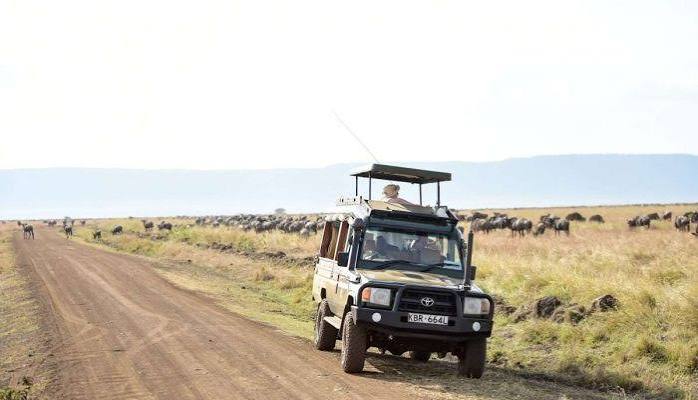
Most people planning a Kenya safari hit the same fork early on: drive between the parks, or fly?
The choice between a road safari vs fly-in safari in Kenya affects your budget, how many hours you spend in transit and, on short trips, which parks you can realistically reach at all.
Both work. Neither is automatically the better buy. What settles it is the shape of your itinerary: how many nights you have, which parks you want to see, how many of you are travelling and how much time you are willing to spend getting from one place to the next.
Put simply, road travel tends to buy you flexibility and shared costs. Flying tends to buy you time.
In This Guide
Road Safari vs Fly-In Safari in Kenya: The Short Answer
Driving suits itineraries where the parks line up into a sensible circuit and you have the days to enjoy it. Nairobi to Amboseli to Tsavo and on to the coast is one example, and a Rift Valley route taking in Lake Naivasha and Lake Nakuru is another. You keep the same vehicle and guide throughout, you can stop when you want, and the cost of that vehicle is shared rather than charged per head, so it becomes more attractive per person as the number of travellers grows.
Flying suits shorter trips, and any itinerary where one leg is far longer than the others. Someone with four nights who wants to spend nearly all of them in the Maasai Mara would spend a significant share of the trip in transit by road in both directions. A flight from Wilson Airport in Nairobi replaces two long driving days with two short sectors, and that usually shows up as extra game drives rather than as comfort alone.
Combining the two is often the strongest answer and it remains under-used. Driving one direction and flying the other gives you the overland journey once without repeating the same long transfer, and it usually lands between the two options on price.
If you are still mapping out the broad shape of the trip, it is worth looking at the range of Kenya safari options first, because the parks you choose will largely make this decision for you.
What Is a Road Safari in Kenya?
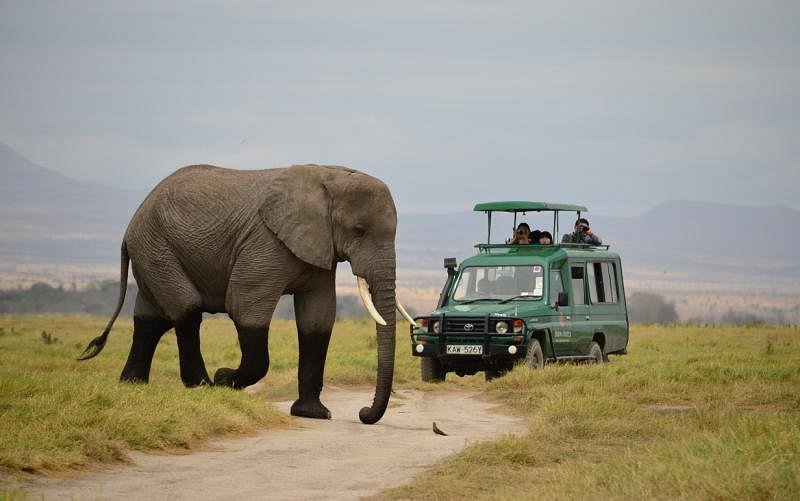
On a road safari you travel between parks in a safari vehicle with a driver-guide, and in most cases that same vehicle takes you on game drives once you arrive. A transfer day usually starts after breakfast and ends with an afternoon game drive at the new park.
What you travel in, and whether you share it, depends on the package booked. Grey Impala’s Kenya safaris are private by default, using a 4×4 with a pop-up roof and your own guide, with shared group departures available on request for solo travellers and stated clearly on the quote.
Elsewhere in the market, more budget-focused programmes often use extended safari vans, which are fine on tarmac and reasonable inside the parks but less capable on rough tracks after rain. Whoever you book with, confirm three things: the vehicle type, whether the safari is private or shared, and whether the same vehicle and guide continue for the whole itinerary.
The practical advantage is control. You can pull over at a Rift Valley viewpoint on the way to Naivasha, stop at a market, take longer over lunch, or leave earlier to reach a park gate before the afternoon light goes. Nothing waits on a departure board.
What Is a Fly-In Safari in Kenya?
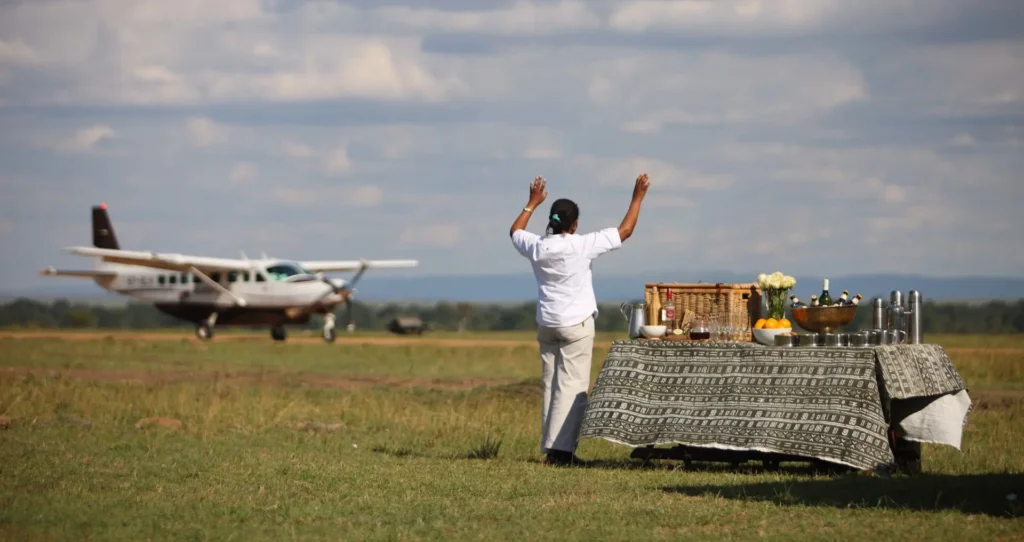
A fly-in safari uses light aircraft to replace the longest road legs. Most safari flights operate out of Wilson Airport in Nairobi rather than the main international airport, and they land at airstrips serving the parks, reserves and conservancies. From the airstrip, the lodge or camp sends a vehicle to collect you, usually a short drive, and your game drives are then run with vehicles based at the destination.
The name confuses some travellers, so it is worth being clear: you are not spending your safari in an aeroplane. You might take two or three flights across a week-long trip, each one short. The aircraft simply removes the transfer days.
Two details matter more than people expect. First, scheduled safari flights often serve more than one airstrip on a routing, so time in the air can be longer than the direct hop suggests. Second, game drives after arrival may be shared with other guests or arranged privately, depending on the camp and the package, which is different from a road safari where the vehicle is normally yours throughout.
If a private vehicle at the destination matters to you, ask for it to be quoted rather than assumed.
Grey Impala plans both styles from Nairobi and from the coast, and the Kenya fly-in safari packages page shows how the flight sectors are usually put together across the Mara, Amboseli and the beach destinations.
Road Safari vs Fly-In Safari: Side-by-Side Comparison
| Factor | Road safari | Fly-in safari |
|---|---|---|
| Transfer time | Hours per leg, sometimes most of a day on longer routes | Short sectors, though airstrip stops and check-in time add to it |
| Overall cost | Vehicle, fuel and guide are shared across everyone travelling, so the per-person figure falls as numbers rise | Charged per person per sector, so the total rises with each traveller and each flight |
| Scenery in transit | You see farmland, escarpments, towns and the change from highland to bush | Good aerial views of the Rift Valley and the plains, but little contact with the country in between |
| Flexibility | High on departure times, stops and small itinerary changes | Shaped by flight schedules and check-in requirements |
| Luggage | Practically limited by vehicle space rather than by weight | Weight limits apply and vary by airline and route |
| Comfort | Depends on the vehicle, the route and the length of the day | Less time sitting, though small aircraft are noisier and tighter than most people expect |
| Groups | Value per person improves as more travellers share one vehicle | Cost increases with every additional seat |
| Families | Private vehicle, own toilet stops, room for bags, but longer sitting periods | Short hops reduce time in transit, though luggage limits and airstrip waits need planning |
| Access | Good to parks on the main circuits; some conservancies involve extra ground driving | Reaches distant and remote areas without losing days |
| Itinerary changes | Easier to adjust en route | Changes usually mean rebooking a seat |
| Game-viewing time | Reduced on transfer-heavy days | Protected, which is the main reason people pay for it |
| Private travel | The vehicle is normally yours throughout | Private aircraft possible by charter; ground vehicle arrangements depend on the package |
Price is where oversimplification does the most damage. A road safari is not automatically cheap and a fly-in safari is not automatically expensive, because the number of travellers, the vehicle arrangement, the route, the number of flight sectors and the season all move the total.
When a Road Safari Is the Better Choice
You Want to See More of Kenya Between Parks
The drive out of Nairobi towards Naivasha climbs to the Rift Valley escarpment and drops into a completely different landscape, past small farms and roadside stalls. Heading south towards Amboseli, the scenery shifts into open Maasai grazing land with Kilimanjaro appearing on clear mornings. This is a real part of the trip for many travellers and flying skips it entirely.
Be honest with yourself, though. Not every transfer is interesting. Some stretches are long, hot and mostly about covering distance.
You Are Travelling as a Family or Small Group
The economics here are straightforward. A safari vehicle costs roughly the same to run however many people are in it, so the per-person cost falls as more travellers share it, while each traveller pays their own fare on each flight sector. That is why road travel often looks better for families and groups, and why the gap narrows for couples. Where the tipping point sits depends on the vehicle, the route and the fares on your dates, so it is worth having both versions costed rather than assumed.
You Want More Flexibility
With your own vehicle you can leave when you like, stop for photographs where it is safe and practical, linger at a sighting on the way out of a park, or add a stop that was not in the original plan. On a longer itinerary you can sometimes swap a night between parks if wildlife movement makes that sensible.
Flexibility has limits. Park gates operate on set hours, lodges hold specific bookings, and distances do not shrink because you feel like a longer breakfast.
Your Parks Fit Naturally Into a Road Circuit
Route design matters far more than the distance between any two points. Amboseli, Tsavo West and Tsavo East sit in a logical line that continues to Mombasa or Diani, so the drives connect rather than doubling back. Lake Naivasha and Lake Nakuru form a compact Rift Valley pairing within reach of Nairobi. Those combinations reward driving, and they are among the routes Grey Impala runs most often from both its Nairobi and coast offices.
A circuit that forces you back through Nairobi between every park is a different matter. If your chosen parks do not sit on a sensible line, road travel starts costing you days rather than saving you money.
When a Fly-In Safari Is the Better Choice
Your Safari Is Short
On a trip of three or four nights, one long road transfer in each direction can take up a quarter of your holiday. Replacing it with a flight typically buys an extra game drive on arrival day and a proper morning drive on departure day. Travellers who want good light at both ends of the day feel this most.
You Are Visiting Remote or Distant Safari Areas
Samburu sits well north of Nairobi and the Maasai Mara well to the south west, and the northern Mara conservancies add extra ground driving beyond the reserve boundary. Flying makes obvious sense for these when time is tight. It is not compulsory. Plenty of travellers drive to the Mara and enjoy it, particularly as part of a longer Rift Valley route.
You Prefer to Reduce Long Road Transfers
Kenya’s main highways are generally good and the drives are not an ordeal, but several hours in a vehicle is still several hours in a vehicle, and doing that on consecutive days wears on some people. Conditions vary: tarmac on the main routes, rougher murram on some final approaches to camps, and slower going after heavy rain.
Comfort and Time Matter More Than Lowest Possible Cost
This is the honest trade. You pay more per person for transport and you get hours back, and on a short trip most travellers conclude that it is worth it.
What Are the Downsides of a Road Safari?
Long driving days are the main one. On transfer days you may spend the bulk of daylight hours moving, arriving with just enough time for a short evening drive. Do that two or three times in a week and the trip starts to feel like travel rather than safari.
Traffic entering and leaving Nairobi and Mombasa is unpredictable and can add a significant amount to any journey that starts or ends in a city, which is why early departures are standard. Fatigue is real, particularly for anyone prone to motion sickness on winding sections, and road quality varies enough that a route which looks fast on a map may not be, especially in the wet seasons.
None of this makes road safaris a weaker choice. It means you should count the transfer days honestly when you look at an itinerary, rather than counting only the nights.
What Are the Downsides of a Fly-In Safari?
Transport costs are usually higher per person, increasing with each passenger and each sector.
Luggage is the restriction that catches people out, and there is no universal Kenyan safari limit. Safarilink currently states 15 kg per person on most of its routes, inclusive of hand baggage and cameras, in soft bags, with 20 kg on certain coastal and regional routes including Diani, Malindi, Lamu and Mombasa. Airkenya Express currently states 15 kg per person in soft bags on all services, again including hand baggage. Charter operators set their own limits, and policies change. Both scheduled airlines ask for soft bags because luggage holds on light aircraft are small and irregular in shape, and both offer a paid freight seat for travellers carrying significantly more. Check the current policy of the airline actually operating your sectors, and pack to the strictest allowance on your itinerary rather than the most generous one.
Beyond luggage: aircraft are small, and passengers who dislike turbulence tend to notice it more than on a jet. Schedules shape your day, weather and operational conditions can occasionally delay flights, which matters most when you have a same-day international connection, and you still need airstrip transfers at both ends.
Road vs Fly-In Safari Costs
Nobody can quote a meaningful price without knowing the itinerary, but the variables are easy to understand.
On a road safari, the cost is built from the vehicle and its category, fuel across the whole route, the driver-guide, the number of passengers sharing that vehicle, the route itself and the number of days. Most of that is a fixed cost divided among everyone travelling.
On a fly-in safari, the cost is built from the airfare per person, the number of flight sectors, the routing, the season, airport and airstrip transfers and whether the lodge game drives are shared or private. Almost all of it is charged per head.
That structural difference explains most real-world quotes, and it is why the comparison shifts as your group grows. Accommodation then sits on top of both and often outweighs the transport decision entirely, which is why a good planner looks at the whole package rather than the transport line alone.
Which Is Better for a 3, 5, 7 or 10-Day Kenya Safari?
Trip length is a strong signal, but it is not the deciding factor on its own. Where you start, which parks you have chosen and how those parks connect all matter just as much.
| Trip length | What often works | Why |
|---|---|---|
| 3 days | Flying is particularly useful when the destination is distant | With two nights on the ground, a long road transfer each way leaves relatively little time in the reserve. Closer options such as Lake Nakuru or Amboseli can still work well by road, especially from Nairobi. |
| 5 days | Either can work, and route design usually decides | Two parks are comfortable. A Naivasha and Nakuru pairing tends to suit driving. A Mara-focused five days often suits flying at least one sector. |
| 7 days | Road circuits usually become practical | Enough time to absorb transfer days and see the country between parks. Flying one sector can still remove a weak link in the route. |
| 10 days or more | Road travel, or a combination | Long enough for a genuine cross-country journey. Many travellers drive the main circuit and fly the one leg that would otherwise use up most of a day. |
Exceptions are common. A three-day trip built entirely around one nearby park can work very well by road, while a ten-day trip hopping between widely separated conservancies may need several flights to hold together at all.
Road or Fly-In Safari by Destination
| Destination | Driving makes sense when | Flying is worth considering when |
|---|---|---|
| Maasai Mara | It forms part of a longer itinerary, particularly when paired with the Rift Valley lakes on the way | The Mara is the main focus of a short trip, or you are staying in the northern conservancies where extra ground driving adds up |
| Amboseli | It sits within a southern circuit continuing towards Tsavo and the coast | You want a two-night stay slotted into a tight schedule from Nairobi, Mombasa or Diani |
| Tsavo East | You are travelling from Mombasa or Diani, where the park is relatively close, or arriving from Tsavo West | You are linking it to a distant park and want to avoid a long repositioning drive |
| Tsavo West | You are arriving from Amboseli, which connects naturally by road | You are joining it to a flying itinerary and want to avoid backtracking |
| Samburu | You are making a longer northern journey and want the drive through the highlands | Time is limited, since the overland journey uses a substantial part of a day |
| Lake Nakuru | Usually, given its position on the Rift Valley route from Nairobi | Rarely necessary when Nakuru is the main destination, though it can suit a wider flying itinerary |
| Lake Naivasha | Usually, as it is one of the more straightforward drives from Nairobi | Seldom for its own sake, though it can join a flying itinerary as a stopover |
| Mombasa and Diani | You are ending a southern circuit at the coast, so the drive doubles as the final transfer | You are combining the coast with the Mara or Samburu, where the overland crossing is long |
Transfer times deserve care. A drive to Amboseli that takes most of a morning from a Nairobi hotel can take considerably longer if you leave during the city’s peak traffic. Flight timings depend on the routing and which airstrip serves your camp. Ask for the actual timings for your dates rather than working from generic figures.
Can You Combine a Road Safari and Fly-In Safari?
Yes, and for many itineraries it is the strongest option. Three structures cover most cases.
Drive out and fly back. You get the overland journey and the landscape once, then skip the repeat performance and arrive back in Nairobi with the afternoon intact, which is useful if you have an evening international flight.
Drive a logical circuit, then fly the long return sector. Amboseli into Tsavo West and on to Tsavo East and the coast is a natural road route, so drive it and then fly back to Nairobi from Mombasa or Diani rather than repeating several hundred kilometres. Travellers heading to the coast should also ask about the Nairobi to Mombasa railway service, which suits some schedules well.
Fly only the transfer that would otherwise consume a day. If your route is otherwise sensible but includes one disproportionately long leg, replacing just that leg often costs less than a fully flying itinerary while removing most of the difficulty.
Which Safari Is Better for Families?
It depends on your children rather than on the transport method.
A private road safari has real practical advantages: your own vehicle, your own toilet and snack stops, room for the bags and gear that children require, and no check-in deadlines to manage. The drawback is the sitting. Younger children may find several consecutive hours in a vehicle difficult, though this varies considerably from child to child and some travel better than their parents expect.
With older children and teenagers the calculation often shifts. They generally tolerate longer drives, and every additional seat on a flying itinerary is charged, so road travel can make better financial sense for a larger family.
Flying suits families whose priority is maximising time at one camp, or who are travelling with a child who genuinely struggles with several hours in a vehicle. Weigh the airline’s baggage allowance carefully, since family packing rarely comes in under the standard safari limits without planning.
Which Is Better for Couples and Honeymooners?
For two people, the difference between the two options can be smaller than expected, because there are fewer travellers sharing the cost of a private vehicle. If your priority is a small number of nights in good camps with minimal time in transit, flying often gives you the better version of that trip.
Road travel still appeals to couples who like the journey itself and are combining several parks over a longer stay. A common compromise is flying into the Mara for the safari section, then continuing to Diani or Watamu for a beach stay, which avoids a long overland crossing between two ends of the country. If you want privacy on game drives as well as in transit, confirm that a private vehicle is included rather than assuming it comes with the camp.
Which Is Better for Photographers?
Road safaris have practical advantages if you carry serious equipment. Gear stays accessible in the vehicle, there is no weight limit beyond available space, you can carry a bean bag or bracket, and the vehicle is normally yours, so you can stay with a sighting instead of moving on to suit other guests.
Flying protects shooting time, particularly on short trips where you want to be in position for first light on your first full morning. The trade-off is the airline’s baggage allowance, described above, which is where most photographers feel the pinch: a body, two or three lenses and a laptop use a large share of a standard safari allowance on their own. Check the current limit for your sectors, ask whether a freight seat is worth buying, and if a private vehicle at the destination matters to you, have it quoted.
How to Choose Between a Road and Fly-In Safari
A road safari often suits you if:
- your parks form a sensible circuit rather than a series of separate trips out of Nairobi
- you have a week or more
- you are travelling as a family or group and want to share transport costs
- you want the same vehicle and guide throughout
- seeing the country between the parks is part of the appeal
A fly-in safari often suits you if:
- you have a few nights and want most of them on game drives
- one destination dominates your plan, particularly the Mara or Samburu
- the overland journey would use up a disproportionate share of the itinerary
- you would rather protect time and comfort than keep transport spend to a minimum
A combination often suits you if:
- your itinerary covers separate regions, such as a southern circuit plus the coast
- one transfer is far longer than the others
- you want the overland experience without doing the same long drive twice
- you have an evening international departure and need the last day intact
So, Which Is Better for Your Kenya Safari?
Let the route decide. A road safari often works best on logical multi-park circuits, longer itineraries, trips with several travellers sharing a vehicle, and for people who value flexibility over saved hours. A fly-in safari often works best on shorter trips, for distant destinations, and where a road transfer would consume a disproportionate part of the itinerary. A combination tends to win when most of your route works well by road but one particular leg does not.
Grey Impala is a Kenyan operator running road, fly-in and mixed itineraries from offices in Nairobi and Mombasa, so the same trip can be costed more than one way before you commit. Share your travel dates, the number of travellers and the parks you have in mind, and the team can show you where paying for a flight genuinely buys useful safari time and where it does not.
Frequently Asked Questions
Is it better to drive or fly to the Maasai Mara?
Flying usually makes more sense when the Maasai Mara is the main focus of a short trip, while driving works better when the Mara forms part of a longer Rift Valley circuit. Two nights in the Mara reached by road means much of two days spent travelling. Six or seven days changes the picture, and the drive becomes part of the trip rather than a cost.
Are fly-in safaris in Kenya worth it?
They are worth it when the flight removes a transfer that would otherwise take a meaningful share of your holiday. On a short trip to a distant reserve the extra spend often buys two or three additional game drives, while on a longer circuit through parks that already sit close together it buys much less.
Are road safaris in Kenya comfortable?
Comfort depends mainly on the vehicle and the length of the day rather than on the roads. A 4×4 with individual window seats on a four-hour transfer is comfortable for most travellers, while a crowded van on a full day of driving is a different experience. Ask which vehicle type is included, whether it is private or shared, and how many hours each transfer day involves.
Can I fly one way and drive the other on a Kenya safari?
Yes, and it is a common arrangement. Driving out and flying back gives you the overland journey without repeating it, and it returns you to Nairobi with time to spare before an evening international flight. It also usually costs less than flying both ways.
How much luggage can I take on a fly-in safari in Kenya?
There is no single answer, because allowances vary by airline and by route, and charter operators set their own. The scheduled safari airlines publish limits well below what most travellers bring on an international flight, they include hand baggage in the total, and they ask for soft bags. Confirm the allowance for the exact sectors in your itinerary and pack to the strictest one.
Is a road safari cheaper than a fly-in safari?
Often, though not always. Vehicle costs are shared across everyone travelling, so the per-person figure falls as the group grows, while flights are charged per seat and rise with each traveller and each sector. Accommodation choice can move the total more than either transport option does.